
Navigate this guide · 1,537 words
The essential signal
- Core losses continue while a transformer is energized, even with little output load.
- Winding losses increase approximately with the square of load current under comparable conditions.
- A useful comparison considers the expected load profile and lifetime cost, not only peak efficiency.
The useful question is where energy goes
A real transformer changes voltage while losing some of its input energy before that energy reaches the load. Some energy is dissipated in its magnetic core and windings. The ENERGY STAR buying guide separates these losses because their behavior differs as loading changes. That distinction is more useful than treating efficiency as one permanent number attached to the enclosure. A device can be efficient under one specified condition while losing a different fraction of its input under another. Start by asking which operating point a quoted efficiency describes and which losses the test includes.[1][2]
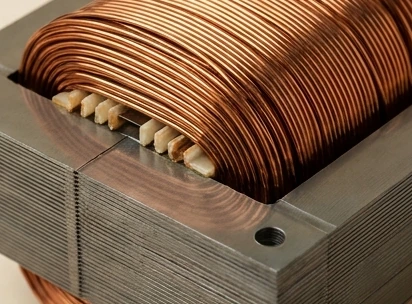
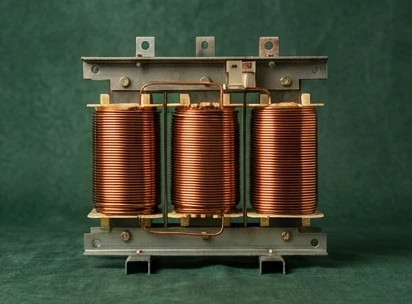
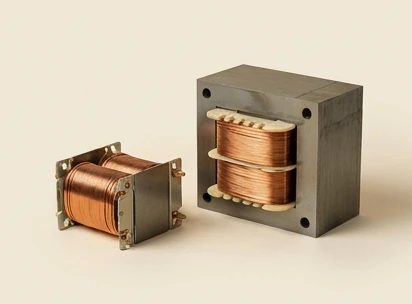
For an EEE student, tracing the energy balance is more useful than beginning with a product comparison. Input power supplies useful output and losses. If the output is small, a modest fixed loss can matter greatly as a fraction of the total. If the load becomes large, losses that rise with current become more important. This article explains that relationship using a simplified loss model, not a certification calculation. The photographs are illustrative engineering artwork. They do not establish a particular transformer's construction, electrical rating, safety compliance or measured performance.[1][2]
Core losses do not wait for useful output
The buying guide associates core losses with energizing the laminated magnetic core. At approximately fixed voltage and frequency, they are treated as nearly constant from no load to full load in its comparison framework. That is why an energized transformer serving a lightly loaded building still deserves attention. Low delivered power does not imply that all losses disappear. The core remains part of the active electrical system. A useful specification therefore identifies no-load loss separately rather than hiding it inside an efficiency percentage that may refer to a different load.[1][2]
It identifies thinner laminations, better magnetic orientation and alternative core materials as ways to reduce those losses. These are design choices with trade-offs, not a reason to declare one material universally best for every installation. Suggested evaluation questions include the manufacturer's tested no-load loss, the applicable test conditions and the expected number of energized hours. Avoid assuming that a modern appearance establishes magnetic performance. Evidence belongs in test documentation. If a supplier provides only promotional language, request the loss values and their measurement basis before attempting a meaningful comparison.[1][2]
Winding losses follow current
Electrical resistance in the windings turns some of the current's energy into heat. In the guide's simplified treatment, coil or load losses vary with the square of loading. If the relevant current doubles while resistance is unchanged, that contribution becomes approximately four times as large. This is a conditional relationship, not a complete prediction for every operating temperature and waveform. Resistance and additional loss mechanisms complicate a real machine. Still, the square relationship explains why a transformer with an acceptable light-load result can behave differently when heavily loaded and why actual duty matters in procurement.[1][2]
The guide explains that larger, lower-resistance conductors can reduce winding loss. That improvement may change size, mass and initial cost. Suggested comparisons should therefore retain both electrical and practical requirements: capacity, installation space, enclosure conditions and the documented loss data. Do not select a device solely because one coil looks larger in an image. This article provides no instructions for modifying windings or operating an exposed transformer. Equipment selection and electrical work require qualified professionals, appropriate standards and manufacturer documentation, especially where hazardous voltage or substantial fault energy is present.[1][2]
Loading changes the efficiency curve
In the guide's simplified model, efficiency peaks where core loss and coil loss are equal. This makes intuitive sense: at low output, nearly fixed core loss carries a large relative penalty; at high output, increasing winding loss carries a growing penalty. Between them lies a favorable operating region. Peak efficiency is therefore not a promise that running at the highest available load is always best. It describes a relationship among useful output, fixed loss and load-dependent loss under defined operating assumptions.[1][2]
Consider an illustrative transformer with 100 watts of no-load loss and 400 watts of winding loss at full load. At half rated current, the simplified winding contribution is 400 multiplied by 0.5 squared, or 100 watts. The two losses are equal at that point. These deliberately invented values illustrate the model; they are not a product benchmark or recommended specification. In a real review, obtain measured values corrected to the relevant test conditions. Also keep loading fraction distinct from the guide's definition of load factor, which compares average load with peak load over a period.[1][2]
A load profile beats a single snapshot
The guide advises matching transformer design to expected loading instead of retaining outdated purchasing assumptions. A single peak observation does not reveal how long the equipment spends at light, moderate or heavy loading. An always-energized transformer with brief peaks has a different loss story from one carrying a sustained load. Suggested planning begins with a time-based description of the application: expected energized hours, approximate load distribution, growth assumptions and seasonal changes. Treat those estimates as an input to engineering review rather than a substitute for measured operational data.[1][2]
An illustrative campus building might have a busy daytime load and much lower demand overnight. Another facility may operate equipment continuously. Selecting both from the same copied specification can miss their different needs. A useful worksheet records the basis for each assumption and includes uncertainty where operating data is unavailable. The objective is not to infer exact annual savings from a generic article. It is to avoid comparing devices against a load condition that rarely occurs in service. Ask a qualified engineer how the proposed ratings and tested losses relate to the actual application.[1][2]
Loss reduction and ownership cost
The ENERGY STAR guide combines purchase price with monetary valuations of no-load and load losses to estimate total owning cost. The important idea is that electricity lost throughout service has an economic cost, even when that cost does not appear on the initial invoice. A cheaper purchase can therefore be more expensive to own under a particular duty and tariff. Conversely, a premium-priced design is not automatically justified. The appropriate comparison needs a documented load profile, consistent loss measurements and financial assumptions that fit the actual owner's operating context.[1][2]
Keep the technical loss calculation separate from the commercial assumptions used to value it. Record which energy price, operating horizon and loss valuation method were used, then examine how the conclusion changes if those assumptions move. Historical dollar values and regulatory details in the 2017 guide should not be treated as current local requirements or current Bangladesh electricity tariffs. This article uses the document for the loss framework, not jurisdiction-specific purchasing advice. Discuss financial and compliance decisions with appropriate specialists and check the latest standards before committing to equipment or claiming a particular payback.[1][2]
Temperature and operating conditions matter
The guide specifies reference temperatures and uses different corrections for no-load and load losses. This matters because comparing numbers measured under inconsistent conditions can produce a misleading result. A neat efficiency table is only useful when its entries mean comparable things. Suggested questions include whether the quoted winding losses include relevant stray contributions, which temperature applies and whether the measurement follows the required test method. Do not silently combine a laboratory result from one condition with a supplier estimate from another and present the result as a verified comparison.[1][2]
The engineering comparison also needs to state the operating conditions. A lower-loss design does not erase installation requirements, loading limits or the need for protection. The DOE research page describes work on transformer materials and dynamic control aimed at reducing losses and improving lifetime performance. These are research objectives, not guaranteed results for any equipment pictured here. For a practical project, distinguish published research goals, manufacturer test data and site measurements. That separation keeps a promising engineering direction from being mistaken for proof that a particular installation will perform as expected.[1][2]
Do not confuse a loss reduction with an efficiency-point increase
Reducing a hypothetical loss from 200 watts to 150 watts cuts that particular loss by 25 percent. It does not increase overall transformer efficiency by 25 percentage points. The denominator matters. A clear reporting practice always states whether a percentage describes lost power, total input power or a monetary saving. The ENERGY STAR guide distinguishes loss savings from efficiency, and preserving that distinction avoids exaggerated claims. Keep units beside values and retain the original calculation so another reader can check what was compared.[1]
Ask better questions before specifying equipment
Begin a comparison with the application and capacity, then document measured no-load loss, load loss and expected operation. The buying guide connects efficient procurement with up-to-date load information and coordinated purchasing decisions. A suggested checklist therefore asks who owns the load estimate, when it was last reviewed and how future changes are represented. Also ask whether a proposed efficiency improvement changes mass, dimensions or installation requirements. These questions help make the selection auditable without pretending that a simple efficiency percentage captures the entire design problem.[1][2]
The aim is not to maximize one attractive number while ignoring the rest of the energy balance. It is to select and operate equipment using an honest picture of how it will be used. Core loss, winding loss, load profile and ownership cost belong in the same conversation, but each should retain its own evidence and assumptions. Read the linked guide for its scope and historical context, then seek current technical advice for the actual installation. An educational model is valuable when it clarifies the right questions. It becomes dangerous when treated as permission to improvise with energized electrical equipment.[1][2]
Questions, answered.
Does an unloaded transformer have zero losses?
No. In the simplified model, energizing the core produces no-load losses even when little useful output is delivered.[1]
Is the highest rated load always the most efficient point?
No. The simplified efficiency peak depends on the relationship between core and winding losses, not merely the highest load.[1]
Read the sources.
- ENERGY STAR guide to buying more energy-efficient distribution transformersUS Department of Energy / EPA · Accessed 2026-10-14
- Distribution and building-level transformer researchUS Department of Energy · Accessed 2026-10-14
AI assistance and source checks reduce risk; they do not guarantee error-free reporting. See our editorial policy.