Navigate this guide · 1,561 words
The essential signal
- The maximum power point depends on the panel characteristic and its operating conditions.
- Perturb-and-observe and incremental conductance use different ways to search for a favorable point.
- Tracking accuracy, converter losses and battery constraints are separate parts of system performance.
Maximum power starts with the panel characteristic
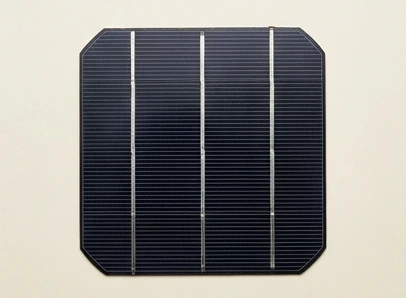
A photovoltaic panel has a voltage-current characteristic; it is not an unlimited supply with a fixed voltage. Texas Instruments explains that the power available from a PV system depends on irradiance, temperature and the current drawn from the cells. Maximum power point tracking, or MPPT, seeks an operating point that extracts favorable power under those conditions. It does not create energy beyond what the illuminated source can provide. That distinction is central to understanding the controller: its job is to operate the source intelligently, not to multiply a panel's physical capability.[1]
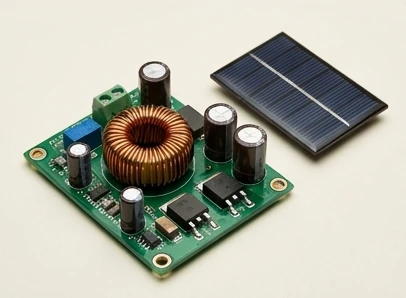
This explanation concerns power-electronics concepts, not rooftop-system wiring instructions. The illustrations show unbranded panels and converter components without claiming to depict a certified circuit. Actual installations require suitable ratings, protection, qualified design and the applicable electrical rules. Start with the panel's documented behavior and the controller's operating limits. A phrase such as smart charging can conceal several different functions, so ask whether the device actually adjusts the PV operating point and how that function interacts with the load. A controller label alone is not a measurement of recovered energy.[1]
Why neither open circuit nor short circuit gives useful maximum power
At any operating point, electrical power is voltage multiplied by current. At open circuit, the terminal voltage may be substantial but load current is essentially absent. At short circuit, current may flow while terminal voltage is near zero. Neither extreme represents the normal point of useful maximum delivered power. TI lists open-circuit voltage, short-circuit current, maximum-power voltage and maximum-power current separately because they describe different aspects of the panel characteristic. A specification sheet should not be read as though its largest voltage and largest current are simultaneously available.[1]
A hypothetical numerical example makes that difference easier to see. If a panel operates at 18 volts and 2 amperes, its terminal power at that point is 36 watts. Those invented values illustrate multiplication, not a particular panel's output, and they do not include converter losses or battery charging constraints. Compare operating points using paired voltage and current measurements taken under comparable conditions. Do not estimate maximum power by multiplying unrelated nameplate extremes. Also avoid unsafe experiments involving intentional shorts on an installation. Characterization methods and suitable test equipment belong in the hands of appropriately trained personnel.[1]
The best point moves with conditions
TI describes PV characteristics changing with irradiance, temperature and illumination angle. The maximum power point is therefore not a permanent voltage that every panel shares under all conditions. A controller that remains at one setting may be adequate in a constrained application but cannot be assumed to track every changing operating condition. The report compares simple approximation methods with iterative search approaches. This helps explain why MPPT is a control problem: the source characteristic changes, measurements contain uncertainty and the converter must choose how to respond over time.[1]
Imagine a panel operating as clouds change the illumination. The controller observes a change in electrical output, but that change may reflect the environment as well as its own recent adjustment. A suggested evaluation plan separates steady-condition tracking from response during environmental transitions. Avoid presenting one successful bench observation as proof of annual energy yield. The article makes no measured performance claim for any algorithm or controller. Read test results in the context of the irradiance profile, temperature, panel configuration and converter used. Those details determine whether a reported tracking result answers the question relevant to your project.[1]
The converter provides a way to influence the source
MPPT generally forms part of a conversion system that can change the load seen by the PV source. TI discusses changing a reference or duty cycle so that the panel voltage moves during a search. The control algorithm and converter therefore serve related but distinct roles: the algorithm decides which direction to explore, while the electrical power stage implements the operating adjustment within its limits. A useful system explanation should describe both. Calling a circuit MPPT does not reveal its conversion topology, supported voltage range or the restrictions imposed by its output load.[1]
Identify the measurements, control decision, converter and energy destination in a block-level review. For a battery application, the destination also has charging requirements. For a grid-connected application, other conversion and protection functions apply. This article does not design those systems or prescribe component values. The important conceptual question is whether the power stage can maintain the requested PV operating point while safely meeting output requirements. If it reaches a constraint, the controller may not remain at the panel's ideal point. That behavior should be documented rather than treated as unexplained failure of the tracking idea.[1]
Perturb and observe asks which direction helped
Perturb and observe makes a small voltage or current change, measures the power response and decides which direction to try next. TI explains that the search reverses direction when power falls. This is an intuitive way to approach a peak without requiring a complete model of the panel. It also introduces a trade-off: the search must disturb the operating point to learn about the local slope. A method that keeps testing around the optimum can spend time on either side of the best point rather than remaining exactly at it.[1]
TI highlights step size and changing irradiance as practical complications. A large adjustment can lead to substantial oscillation, while a small one can slow the response. A rapid environmental change can also make the controller interpret a power change incorrectly. Suggested evaluation therefore examines the selected step size and the timing of measurements, not only the algorithm's name. Do not assume that all implementations of perturb and observe behave identically. Their measurement quality, filtering, decision intervals and handling of constraints matter. This is an explanation of the control principle, not a promise that one particular implementation outperforms alternatives.[1]
Incremental conductance examines the slope
TI explains incremental conductance through the relationship between incremental and instantaneous conductance at maximum power. For power P equal to V multiplied by I, the slope with respect to voltage is I plus V multiplied by dI/dV. At the ideal stationary peak, that slope is zero, giving dI/dV equal to negative I/V. The controller uses measured changes to decide where the operating point lies relative to the peak. This mathematical condition explains the method's name and distinguishes it from simply checking whether the last power perturbation helped.[1]
Measurements cannot supply a perfect mathematical derivative. TI discusses the effect of noise and the need for noise reduction or a nonzero decision tolerance. A suggested implementation review asks how the controller estimates changes, how many observations contribute and what threshold prevents endless reactions to tiny fluctuations. The source identifies incremental conductance as useful under rapidly varying irradiance, but that should not become an unconditional claim that every version is superior. Sampling, converter dynamics and measurement uncertainty remain part of the result. Treat the control law as one ingredient of a system whose actual behavior must be tested.[1]
Tracking efficiency is not total system efficiency
Successful panel tracking does not mean the converter itself loses no energy. These are different questions. TI's report focuses on MPPT approaches and explains that the system's objective is to obtain available PV power under varying conditions. It does not establish that a good tracking decision eliminates losses elsewhere. A suggested comparison separates tracking performance at the PV terminals from electrical conversion performance and the energy ultimately delivered to the destination. Combining these into one unexplained efficiency percentage makes it difficult to identify which part of the system needs improvement.[1]
In a hypothetical charger, permissible battery-charging conditions can also constrain the output. The correct response to a full battery is not necessarily to extract the maximum available panel power regardless of destination. This is a system-level design observation, not a charging recipe or specification for a particular chemistry. Review the manufacturer's charging requirements and protection features. Likewise, a nameplate watt rating describes a stated test condition, not guaranteed output at every moment. Keep available solar energy, tracking accuracy, conversion losses and load acceptance separate when interpreting measurements or comparing a controller with a simpler design.[1]

Explain what a comparison actually measured
Check whether an MPPT result measures panel-terminal power, converter-output power or energy delivered over time. These are not interchangeable. A useful test log keeps voltage and current pairs, timing and operating conditions beside the claimed result. TI describes how search decisions depend on changing illumination and noisy measurements, so a short favorable snapshot cannot establish long-term performance. This distinction is especially important when comparing algorithms: retain the same source conditions where possible and label any simulation or hypothetical example rather than presenting it as field evidence.[1]
Test the search, the limits and the assumptions
TI concludes that the right method depends on the application, including noise, speed and implementation cost. It also describes combining approaches, such as an initial estimate followed by iterative searching. A suggested learning project begins with a documented panel model or safe controlled source, then records voltage, current, calculated power and controller decisions. Test steady conditions and controlled changes separately. Include cases where the power stage reaches a limit so the observed behavior is not incorrectly blamed on the search rule alone. These tests illustrate reasoning, not installation readiness.[1]
MPPT's useful promise is bounded: it seeks and maintains a favorable operating point as conditions change. It cannot compensate for every unsuitable panel, output constraint or unsafe circuit. Compare algorithms using explicit conditions and measurements rather than slogans about extra power. For an actual solar installation, seek current engineering guidance and qualified electrical work. For study, learn to connect the I-V characteristic, the power curve, the control decision and the converter response. Understanding those relationships makes future technical specifications easier to evaluate without turning marketing terminology into assumed evidence.[1]
Questions, answered.
Does MPPT increase the physical sunlight reaching the panel?
No. It adjusts electrical operation to seek favorable power from the source under the existing illumination and operating conditions.[1]
Is perturb and observe always the best algorithm?
No. TI discusses trade-offs involving step size, changing irradiance, noise and implementation requirements.[1]
Read the sources.
- Introduction to photovoltaic systems maximum power point trackingTexas Instruments · Accessed 2026-10-14
AI assistance and source checks reduce risk; they do not guarantee error-free reporting. See our editorial policy.