Navigate this guide · 1,974 words
The essential signal
- Meta's Muse Spark Open — 816B total parameters with 42B active, a million-token context window — is the biggest US open-weight release since Llama, downloadable from Hugging Face and major clouds.
- The headline demo (two Apple M5 Ultra Mac Studios) is real, but the hardware costs over $20,000 and the Muse Model License limits commercial use — "open-weight" is not "open source."
- It arrived in a 48-hour open-model wave alongside NVIDIA's Nemotron 3.5 and Black Forest Labs' FLUX 3 — the industry's center of gravity is shifting from rented APIs to models you can own.
The week AI moved onto your desk
Something shifted this week in AI, and it did not happen inside a giant data center. In the space of about 48 hours, Meta released the weights of an 816-billion-parameter model, NVIDIA shipped a new family of open multimodal models, and Black Forest Labs put a frontier-grade image generator on a single gaming GPU [1][2][5]. Three releases, three different scales, one shared idea: the best AI is starting to run on hardware you can actually own.[1][2][5]
That is a genuine change in the industry's weather. For the last two years, the frontier has lived behind APIs — you rent intelligence by the token, and the model itself stays on someone else's computers. This week flipped the script, at least partly. The question worth asking is not just what was released, but what "downloadable" really buys you — and what it costs.[1][2][5]
What Meta actually released
On Thursday, in its second major model launch of the week, Meta unveiled Muse Spark Open and called it "the most capable US open-weight model to date" [1][2]. The numbers are striking: 816 billion total parameters, 42 billion of them active on any given token, and a context window of one million tokens — 1,048,576, to be exact [1][2]. It is natively multimodal, taking text, image, audio and video as input, and Meta built it for coding, code review, complex software engineering, multi-step reasoning and long-running agentic tasks [1][2].[1][2]
The release also fulfills a promise Meta made back in April to publish the weights of its Muse Spark line, and it is the company's first meaningful contribution to the US open-source ecosystem since the Llama models [1]. The weights went up on Hugging Face, Amazon, Google Cloud and Microsoft on day one, and the model was simultaneously available through a long list of inference providers — Baseten, Fireworks AI, Groq, Modal, Nebius, OpenRouter and Together AI [1][2].[1][2]
816 billion parameters, 42 billion awake
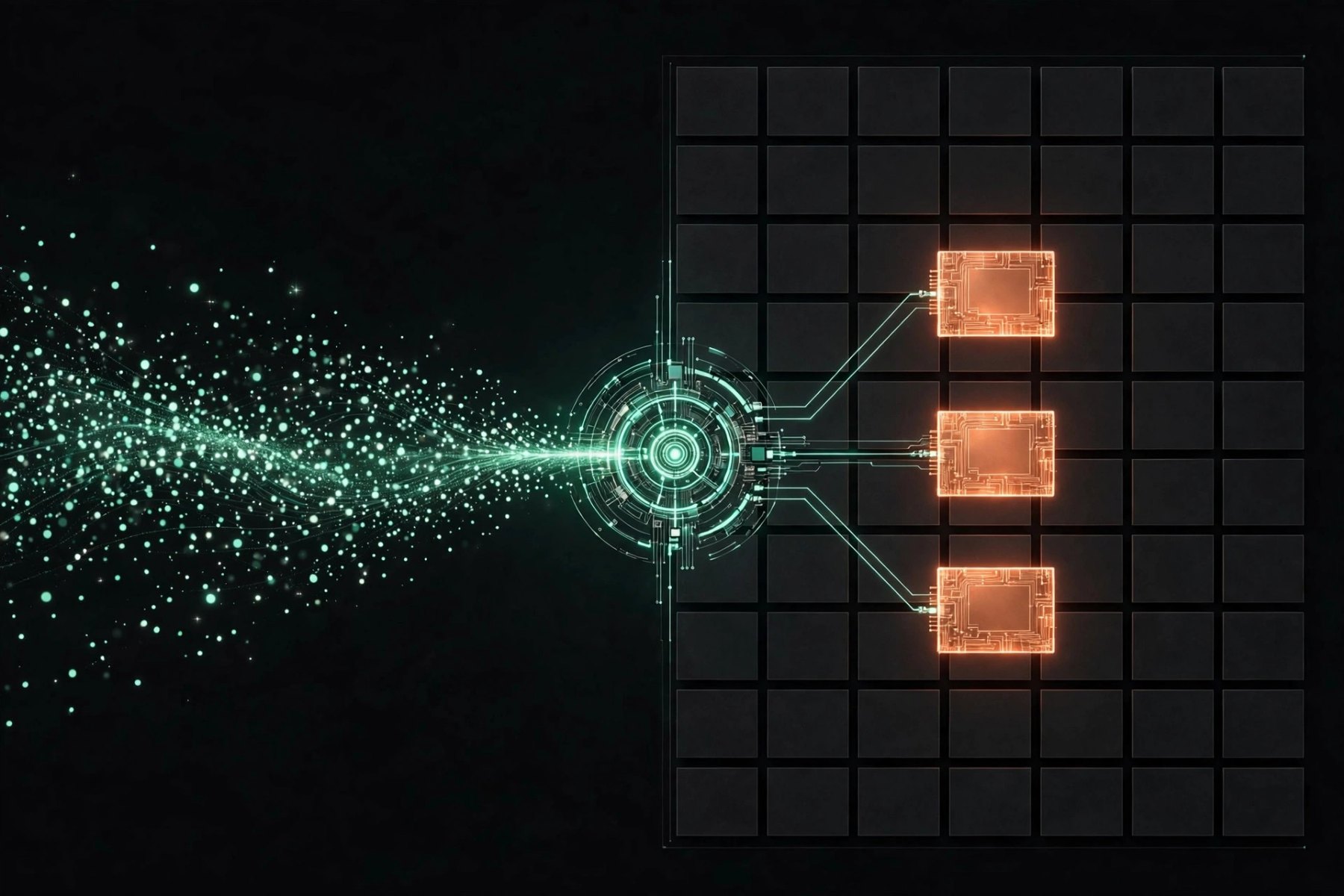
The parameter count needs unpacking, because 816 billion sounds like you would need a data center to run it — and in a sense you would, if all of it had to fire at once. Muse Spark Open is a mixture-of-experts design: the model is organized as a large collection of smaller specialist networks, and for each token only a routed subset — 42 billion parameters' worth — actually does work [1][2]. The rest stays dormant, waiting for the inputs it is good at.[1][2]
This is the trick that has made giant models practical. Training a dense 816-billion-parameter model where every parameter fires on every token would be ruinously expensive to run; the mixture-of-experts layout buys most of the capacity at a fraction of the per-token cost. It is also why the model can plausibly run outside a data center at all — 42 billion active parameters is still enormous, but it is an amount of compute that very high-end local hardware can serve, rather than something only a cluster can touch.[1][2]
A million tokens of context
The context window — one million tokens — deserves its own moment. A token is roughly three-quarters of an English word, so a million tokens is on the order of 700,000 words: several long novels, or an entire mid-size codebase, held in the model's working memory at once [1][2]. For coding and agentic work, which Meta names as the model's home turf, that matters enormously: the model can keep a whole repository, its history and its documentation in view while it works.[1][2]
Long context is also where open models have historically lagged the closed frontier, so matching the million-token mark in downloadable weights is a real milestone, not a marketing flourish. The honest caveat is the usual one with long context: advertised window size and effective use of that window are different things, and independent testing will show how well the model actually reasons across the full million. Early tester feedback is encouraging — Ollama's Dong Chen praised its handling of long context and multi-step tool calls — but that is a first impression, not a verdict [2].[1][2]
The Apple surprise
The strangest part of the announcement was not the model but the demo. Meta worked with Apple to show Muse Spark Open running on a desktop setup: two 512GB Apple M5 Ultra Mac Studios linked together, running through Apple's MLX machine-learning framework [1][2]. Meta said this is the first model of its size class capable of running on that setup — and Apple evidently agreed it was worth showing off.[1][2]
The technical reason it works is Apple's unified memory architecture: the M5 Ultra's integrated GPU can address up to 512GB of memory per machine, and Meta says the chip's 1.2 TB/s of memory bandwidth is fast enough that two machines behave like a single system with a terabyte of unified memory [2]. Zuckerberg publicly thanked Apple CEO John Ternus for the collaboration; Ternus replied that "Mac Studio keeps pushing the boundaries of on-device AI" [1][2]. Two companies that compete on headsets and messaging, teaming up to prove the biggest downloadable model of the year runs best on a Mac — that is a remarkable image, whatever you think of the marketing.[1][2]
"Open-weight" is not "open source"
Before you start planning a home AI lab, the first catch: the license. Muse Spark Open ships under the Muse Model License, which Meta describes as carrying limited commercial terms [2]. As TechBooky noted in Tech Featured's coverage, a downloadable model is not the same as open-source software: you can download the weights and run them for free, but developers should read the conditions before treating the model as unrestricted [2]. The week's roundup coverage puts it plainly — the license lets many developers use the model commercially, but within limits [5].[2][5]
This distinction matters more than it sounds. True open-source software gives you the freedom to use, modify and redistribute with minimal restriction. Open-weight releases give you the artifact — the trained parameters — under the vendor's terms, which can include limits on commercial scale, requirements to label derivatives, or restrictions on competing uses. None of that makes the release worthless; the weights being downloadable and inspectable is still a huge step up from an API-only model. But "free to download" and "free as in freedom" are different things, and the industry keeps blurring them.[2][5]
The $20,000 catch
The second catch is the hardware. The 512GB Mac Studio Meta used for its demo has not even been released yet — it is expected later this month — and the existing 256GB Mac Studio already costs more than $10,000 [2]. Two of the bigger machines, which is what the full model needs, puts the "desktop" in question at well over $20,000. Running a frontier model on your own hardware is real. It is just hardware priced like a car.[2]
For everyone else, the practical route is hosted inference, and Meta clearly planned for that: the model launched day-one on Baseten, Fireworks AI, Groq, Modal, Nebius, OpenRouter and Together AI [1][2]. That is arguably the more important half of the story. The weights being public means a competitive market of providers can serve the model, fine-tune it and drive the price down — which is exactly what happened with Llama. You may never own the $20,000 desk, but you benefit from the fact that someone can.[2]
The benchmarks — read them like an adult
Meta's benchmark claims are strong: the company reports wins over Thinking Machines, NVIDIA's Nemotron, Mistral, Moonshot, Z.ai and Alibaba on model-context-protocol tasks, academic benchmarks, deep reasoning and hallucination measures [1]. Here is the part worth reading twice: Moonshot's Kimi K3 still beats Muse Spark Open on Terminal-Bench 2.1 and DeepSWE 1.1, the coding and software-development benchmarks [1]. A model can be the best open-weight release of the year and still lose specific fights.[1][2]
And the deeper caveat is the one we always apply: these are vendor-reported numbers. Meta ran the tests, chose the competitors and wrote the announcement. Independent evaluation will take weeks, and history says some claims will soften under it. Meta also shipped Helion GPU kernels alongside the model with reported kernel-level speedups of 1.03x to 3.95x on NVIDIA and AMD GPUs — again, Meta's own testing, treat as directional [2]. The benchmarks are a reason for interest, not a verdict.[1][2]
Two tracks: Wonder and Spark Open
The most telling part of Meta's week is the pairing. On Tuesday, Meta launched Muse Wonder — its first frontier model — with the best version locked behind an API [2][4]. On Thursday, it gave away the weights to Muse Spark Open. Two launches, three days apart: one model you rent, one model you can download. The industry's business model, stated out loud in a single week.[2][4]
Closed models keep getting more expensive to access at the top end, with rate cards and usage tiers multiplying. Meanwhile, Meta just put an 816-billion-parameter model in the public's hands for free, on the same week it told API customers to pay for its best closed model [2]. That is not charity. Meta wants developers building on its weights instead of its rivals', and it wants the inference ecosystem competing to serve its model cheaply. For developers, the practical question is simpler: do you want the model you can inspect, host and fine-tune yourself, or the slightly better one that lives behind someone else's API? This week, Meta made you answer that question twice.[2][4]

NVIDIA's Nemotron 3.5: the other open release
Meta was not the only one feeding the open ecosystem on Thursday. NVIDIA unveiled Nemotron 3.5 Super VL, an open multimodal model with 120 billion total parameters and 12 billion active, built for complex agentic enterprise workflows [1][3]. Alongside it came Nemotron 3.5 Bolt in two sizes — a 74B-A9B 24GB build and a 4GB E4B build — and all three shipped fully open: weights, datasets and training recipes [3].[1][3]
NVIDIA's motivations are worth a clear-eyed look. Omdia analyst Alexander Harrowell told TechTarget the quiet part: NVIDIA is "doing this to support the wider ecosystem around their GPUs" — open models that run best on NVIDIA hardware sell NVIDIA hardware [3]. Earlier the same week, NVIDIA also made its Run.ai GPU-orchestration platform open source [3]. Self-interest and genuine ecosystem contribution can be true at the same time; the result is still more capable open models for everyone else.[1][3]
The small end: FLUX 3 on a gaming PC
The week's most democratic release came from Black Forest Labs. FLUX 3 Image Klein is a 5.6-billion-parameter open-weight image model — text-to-image, instruction-based editing and up to ten reference images in one model — and its INT8 build runs on a GeForce RTX card with just 8GB of video memory, the kind of card inside an ordinary gaming PC [5][6]. The lab reports a one-megapixel image in about four seconds on an RTX 5090 and under nine seconds on an RTX 4070 [5][6].[5][6]
The license is notably permissive for its class: free for commercial use below $5 million in annual revenue, under the FLUX Kommunity License [6]. And the lab's own evaluations claim it leads open-weight image models on quality benchmarks — company numbers, treat accordingly [6]. The point stands regardless: an 816-billion-parameter language model needs a $20,000 desk, while a frontier-grade image model now fits on a gaming laptop. Openness is arriving at every scale at once.[5][6]
The bottom line: from renting intelligence to owning it
Zoom out, and the week's real story is not any single model. It is the direction of travel: the most capable AI is becoming something you can download, inspect, fine-tune and run — on hardware ranging from a gaming PC to a pair of Mac Studios to the usual cloud providers [1][3]. Closed models are not going away; Meta's own two-track week proves the API business is alive and well. But the gap between "the best model" and "the best model you can own" just got much smaller.[1][3]
What to watch now is what always follows an open release: independent benchmarks in the coming weeks, the fine-tunes the community builds, and the price war among inference providers serving the same weights. The open-weight race has quietly become the more interesting half of AI — and this week, it had its biggest week yet.[1][3]
Questions, answered.
What is Muse Spark Open?
Meta's 816-billion-parameter open-weight AI model, released 15 October 2026: a mixture-of-experts design with 42B active parameters per token and a million-token context window, built for coding and agentic work [1][2].[1][2]
Can I really run it on my own computer?
In principle, yes — Meta demoed it on two linked Apple M5 Ultra Mac Studios — but the full setup costs over $20,000 and the 512GB model is not even released yet. Hosted inference through providers like Together AI, Groq or Fireworks AI is the practical route for most people [1][2].[1][2]
Is it actually open source?
No. It ships under the Muse Model License with limited commercial terms: you can download and run the weights, but developers should read the conditions before treating it as unrestricted open-source software [2][5].[2][5]
How is it different from Meta's Muse Wonder?
Muse Wonder, launched two days earlier, is Meta's closed frontier model, available API-only with the best version locked away. Muse Spark Open is the downloadable counterpart: slightly different positioning, fully in your hands [2][4].[2][4]
Where can I download it?
The weights are on Hugging Face, Amazon, Google Cloud and Microsoft, released 15 October 2026; it is also served day-one by Baseten, Fireworks AI, Groq, Modal, Nebius, OpenRouter and Together AI [1][2]. Author's referral: I work with these models on Muse's platform. Redeem my code QRQ04M in Settings within 48 hours of joining at https://muse.ai/join — we'll both get 1 billion Muse tokens.[1][2]
Read the sources.
- Meta makes its open models comebackThe Deep View · Accessed 2026-10-20
- Meta Just Released an 816-Billion-Parameter Model You Can Download. Here Is the CatchTech Featured · Accessed 2026-10-20
- Open source and on device: the strategy behind Nvidia's new AI modelsTechTarget · Accessed 2026-10-20
- This Week in AI: New models, security lapses and a market reckoningForbes India · Accessed 2026-10-20
- Three Big AI Releases This Week Run on Your Own Hardware. Why Should You Care?6 Sense Tech (Medium) · Accessed 2026-10-20
- Black Forest Labs' open-weights image model FLUX 3 Image Klein runs on consumer GPUs with just 8 GB of VRAMThe Decoder · Accessed 2026-10-20
Contributor articles and source links do not guarantee error-free reporting. See our editorial policy.